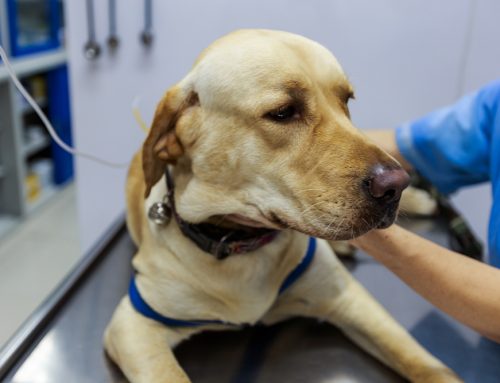


Four kinds of gear send dogs in with real injuries: chews hard enough to fracture or wear down teeth, toys that get swallowed or lodge in the throat, collars that tighten on the neck and cause cervical spinal pain or flare tracheal collapse, and the ones with prongs or shock that leave punctures and burns. A swallowed toy, a piece of bone or rawhide caught in the throat, or a dog who starts retching, drooling, or refusing food after part of a chew goes missing needs to be seen right away. A chipped tooth from a dense chew, a cough that shows up only on the leash, and stiffness after long walks in a dog who pulls hard all need an appointment within a day or two, not an open-ended wait. Prong and shock collars also do damage that no exam will show, since the fear they create tends to outlast the behavior they were bought to stop.
It is not careless to hand a dog the chew that cracks a tooth, since the dense ones sit on the same shelf as the safe ones and no label tells you which is which. At Bayview Animal Hospital, a chip or a wear line gets a close look during exams for dogs and cats in St. Petersburg, and some teeth are fine to watch while others need dental cleanings and extractions once a hard chew has split them. For a dog who pulls into a collar and seems stiff or sore the day after a walk, we check the neck and spine, and laser therapy can ease sore joints and the arthritis building underneath as they age. If a chew, a toy, or a collar has hurt your dog, get your dog on our schedule, and tell us right away if you think a piece was swallowed.
The Gear Most Likely to Hurt Your Dog
- Real bones, antlers, hooves, and hard nylon chews are the ones that fracture teeth, and the quickest screen is whether the chew gives at all when you flex and press it in your hands.
- A swallowed toy piece, a chewed-off rope strand, or a softened wad of rawhide can block the gut, and a dog who's gagging, drooling, or off their food can't wait.
- Prong, choke, and shock collars carry risks to the trachea, the skin, and the temperament, and reward-based training gets the same behavior without any of them.
- Front-clip harnesses and head halters move the pull off the throat, and a fixed-length leash beats a retractable one.
Which Gear Injuries Need a Vet, and How Fast?
Gear injuries land in four places: the mouth, the throat and gut, the neck and spine, and the skin under a strap. Throat and gut trouble is the urgent one, since a lodged or swallowed piece can block an airway or an intestine.
| Where it shows up | What you might notice | How fast to come in |
| Mouth | A broken, discolored, or crooked tooth, a dark spot at the end of a worn-down tip, bleeding gums, pawing at the face, or noticeably worse breath | Within a day or two |
| Throat and gut | Gagging, retching, heavy drool, vomiting, a drop in appetite, or a chew missing a piece nobody can find | Call right away |
| Neck and spine | Coughing or hacking only on the leash, a neck your dog won't turn, or soreness the morning after a long walk | Within a day or two |
| Skin | Redness, thinning hair, or a raw patch where a collar or harness sits | Within a day or two |
Don't try to make your dog vomit unless we've told you to, since a sharp fragment can do more damage coming back up than it did going down, and don't go fishing in the throat for something you can't see. Never reach for ibuprofen or naproxen from your own cabinet for a sore neck, since both are toxic to dogs even at small doses.
Is My Dog's Collar or Harness Causing a Problem?
A dog shows the problem in their behavior before the skin shows a mark. Lip licking, yawning, whale eye with the whites showing, and a body that goes stiff and still are all canine body language for discomfort. Watch the face and the posture while the gear goes on, not after.
Other signals worth knowing:
- Avoidance: your dog ducks away, wanders off, or heads for another room when the leash comes out.
- Tail and ears: a tucked or unnaturally low tail and ears pinned flat are stress, not stubbornness.
- Physical signs: pawing at a collar, hair thinning along a strap line, or a limp that only turns up after a long walk.
Fit is often the culprit, and it's hard to judge on your own dog. Humid St. Petersburg weather adds to it, since a strap left damp and sand-covered after a beach walk can rub a patch raw faster than a dry one. Bring the collar or harness to your dog's next visit if you're unsure, and we'll put it on, show you where it should sit, and check the skin underneath.
Do Prong, Choke, and Shock Collars Work, and What Works Better?
All three stop a behavior by hurting or startling a dog, and training collars that rely on pain only teach a dog what to avoid, never the behavior you wanted. They can injure the neck and the skin on top of that. Reward-based training gets you the same loose leash without any of it.
- Prong collars and choke chains: both close around the neck when a dog pulls, so a sudden lunge lands the full force of the dog's body weight on the trachea, neck, and spine. Prong collars are linked to tracheal damage, punctured skin, and repeated pressure over the thyroid gland, and they're especially risky for dogs with tracheal collapse or disc disease.
- Shock collars: sold as e-collars or stimulation collars, they can make the behavior you targeted worse, because aversive training methods raise a dog's baseline stress and build fear of whatever happened in the second before the shock. The contact points also burn and irritate the skin they sit against.
Reward-based training pays for the loose leash instead of punishing the pull. A dog who gets a small treat every few steps while the leash stays slack learns that keeping it slack is what earns the treat. A prong collar can stop the pulling tonight, but it never touches the stress or the excitement that started it, so the pulling usually returns once the collar comes off, sometimes with more worry attached.
Leash reactivity often responds to a technique called engage-disengage, where your dog learns to notice a trigger calmly and then look back at you. Pay that glance back with a treat your dog loves, and with practice the trigger stops being frightening.
Which Walking Gear Do Veterinarians Recommend?
Head halters and harnesses move the pull point off the throat entirely, and paired with a fixed-length leash, most pulling becomes workable. A front-clip harness suits the average puller, a head halter helps with the strongest ones, and a flat collar earns its place holding ID tags rather than taking the force of a lunge.
| Gear | Best for | What it does |
| Front-clip harness | Dogs who pull | Redirects forward motion from the chest rather than the neck |
| Head halter | Strong pullers | Gentle control at the head, with a slow, treat-paired introduction |
| Back-clip harness | Easy walkers | Comfortable, with no pressure on the throat |
| Martingale collar | Narrow-headed dogs like Greyhounds and Whippets | Keeps a dog from backing out; fitted so it can't close past neck width, it doesn't choke |
| Flat collar | ID tags and everyday wear | Right for tags, wrong as the clip point for a dog who pulls |
Build matters as much as behavior. A short-faced dog, a long-backed dog, and a dog with arthritic hips may each do better in something other than the obvious pick, and when it's the arthritis setting the limit, pain medication and laser therapy help more than a change of harness. Our veterinarians can watch how your dog moves and tell you which to try first.
Why Not a Retractable Leash, and What About Long Lines?
The thin cord on retractable leashes cuts and friction-burns both dogs and the people holding them, a hard lunge from a big dog can snap it outright, and the mechanism pays out line at the moment the dog pulls, which rewards the pulling. A dog sixteen feet ahead of you is also sixteen feet from help when a loose dog rounds the corner.
Loose-leash walking is built instead on a fixed four-to-six-foot leash for everyday walks, with a fifteen-to-thirty-foot long line for recall practice in open space. The long line trails behind your dog in a field, so you can step on it the day recall falls apart.
What Kinds of Toys Cause the Most Injuries?
Toys cause trouble two ways: they break down into pieces small enough to swallow, or they're rigid enough to fracture a tooth. Gastrointestinal foreign bodies run the whole range from a day of mild upset to a blockage that only surgery can clear.
- Rope and fabric toys: strands come off a few at a time and a hard chewer swallows them without anyone noticing, which can become a linear foreign body, a string-like object that bunches the intestine as it travels.
- Squeakers and stuffing: an exposed squeaker is a choking hazard, and swallowed filling packs together into a plug.
- Hard plastic toys: rigid enough to fracture teeth in a determined chewer.
- Undersized balls: anything that fits all the way into the mouth can go down whole, so a ball should be too big to swallow.
- Tennis balls and other abrasive toys: the fuzz holds grit, and a dog who fetches daily can grind the enamel flat until the softer dentin beneath it is exposed.
Retire a toy the day it starts shedding pieces, supervise anything new until you've seen how your dog handles it, and size up rather than down.
If part of a toy has gone missing and you can't account for it, call us rather than waiting to see what turns up in the yard. An object still sitting in the stomach is a different problem from one that's already moved into the intestines, and digital x-rays show us which situation we're in.
Can a Chew Really Break My Dog's Tooth?
A dense chew can split a perfectly healthy tooth in a single bite. The chews too hard for a dog's teeth are real bones, antlers, hooves, and hard nylon, and the tooth that cracks most often is the large upper carnassial, the big chewing tooth toward the back, where a fracture that reaches the pulp usually ends in extraction. Years of grinding against a rigid object also wear the tip down until the pulp underneath is exposed, which can set up a tooth root abscess with no dramatic crack at all.
- Real bones, raw or cooked: a leading cause of fractured carnassials, and the cooked ones splinter on top of that.
- Rawhide: swells and turns gummy as a dog works it, and a swallowed chunk can stick in the esophagus or the small intestine.
- Antlers and hooves: these break slabs off the premolars, and the break is often found weeks later, when your dog has quietly switched to chewing on the other side.
- Hard nylon bones: can break into sharp points that scratch the gut on the way through.
- Any chew worn down to a nub: small enough now to swallow whole, so it belongs in the trash.
Most of each tooth sits below the gumline where no exam can reach, so an x-ray is what settles whether a cracked tooth comes out or gets watched. The sooner a broken tooth is looked at, the better the chance something other than extraction is still on the table, which is why a chip is worth a visit this week rather than at the next wellness exam. We'll go over what the image shows with you before anything is decided, and removing a fractured tooth is part of what we do here.
Which Chews and Toys Are the Safer Picks?
If a chew doesn't flex or give at all under pressure from your hands, it's harder than the tooth that has to work on it, which rules out most of the chew aisle. Look for products carrying the Veterinary Oral Health Council seal, given only to chews with demonstrated plaque or tartar control, as the ideal chew that’s both safe and has dental benefits. Every new chew deserves supervision the first few times, whatever the label says.
On the toy side, the best options engage the brain more than the teeth: a rubber toy stuffed with canned food and frozen overnight, a puzzle feeder that stretches dinner to twenty minutes, a snuffle mat that turns kibble into a sniffing job, and a treat-dispensing toy sized so it can't disappear down the throat.
Dental chews slow new plaque but can't remove tartar that has already hardened onto a tooth, and that takes a professional cleaning.
When Is Destructive Chewing a Medical Problem?
New or sudden destructive chewing in an adult dog isn't always simple mischief or boredom, and it can trace back to pain, anxiety after a household change, cognitive change in a senior, or an endocrine problem shifting appetite and behavior. Dental pain is one families rarely suspect, and it can look like a dog who suddenly wants to gnaw wood or metal. A senior with cognitive change may get restless in the evening and chew things they walked past for a decade.
That change calls for an exam rather than a new chew toy. Digital x-rays let us look at the mouth and the joints the same visit, and we'll recommend bloodwork to check the organ and hormone values that could explain a shift this abrupt.
Questions About Toys, Rawhide, and Harnesses
My dog swallowed part of a toy but seems fine. Do we still need to come in?
A dog who swallowed part of a toy is worth a call even when they look completely normal, because an object can sit quietly in the stomach for a day or two before it causes any trouble. Size, shape, and material all change the risk: a scrap of fabric behaves nothing like a shard of nylon. Surgery to remove a swallowed object is within the range of soft tissue surgery we do here.
Are rawhide alternatives really any safer?
Most are a safer trade, though safer isn't the same as risk-free. Collagen chews and similar products break down more predictably than real rawhide, which swells and softens into a dense mass that can get stuck on the way down.
Is a harness always better than a collar for a puppy?
A harness is usually the kinder choice while a puppy is learning to walk, since a young trachea handles pressure poorly and puppies lunge at everything. A flat collar is still the right place for ID tags. Recheck the fit every few weeks through the growth months, and you should be able to slide two fingers under any strap without forcing them.
Choosing Toys, Chews, and Collars That Fit Your Dog
The right gear depends on the dog: a sixty-pound chewer who guts a plush toy in a minute needs different equipment than a senior who gums the same one for a year. Book an appointment and bring the chew, the toy, or the collar to your next visit at Bayview Animal Hospital in St. Petersburg, and we'll tell you honestly what we'd keep and what we'd swap out.